
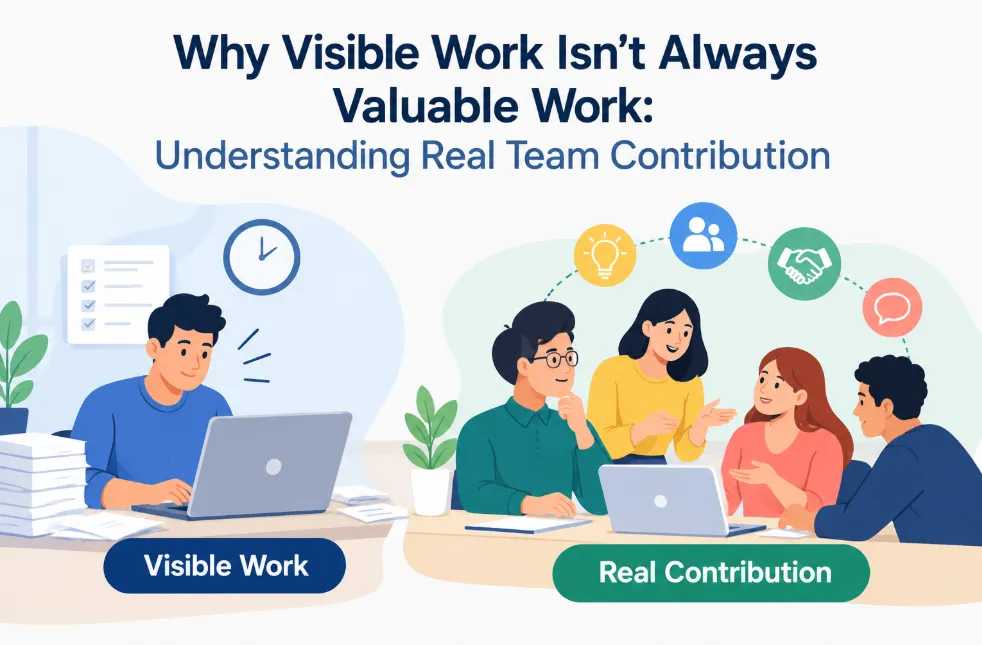
Ask most managers who their top performers are, and they’ll point to the people who speak up in meetings, hit their numbers, or hold the most impressive titles. These signals matter, but they capture only part of the picture. Some of the most valuable contributions in any organization never appear on a dashboard or in a performance review.
The Hidden Work That Keeps Teams Running
Think about the colleague who answers a new hire’s questions at 4 p.m. on a Friday. Or the person who quietly connects two departments that rarely talk, or the one who turns a half-formed idea into a workable plan. This work is rarely measured, but it shapes how well a team functions.
Researchers who study organizations often call this informal collaboration, and it forms a network of its own that runs alongside the official org chart. When that network is healthy, knowledge flows freely, problems get solved faster, and people feel supported. When it isn’t, silos form, burnout spreads, and good ideas stall before they reach anyone who can act on them.
The Risk of Over-Reliance on Key People
Informal networks also reveal a less comfortable truth: many processes depend heavily on a handful of individuals. A single person may be the only one who understands a critical workflow, or the default contact for every cross-team question. That works until the person goes on vacation, changes roles, or leaves the company.
Because this dependency is invisible in standard reporting, leaders often discover it only when something breaks. By then, the cost is already high: lost knowledge, delayed projects, and an overloaded employee who was carrying more than anyone realized.
Making Collaboration Measurable
This is where workplace analytics becomes useful. Rather than relying on gut feeling or annual reviews, organizations can look at how people actually work together. Platforms such as HiveHR help companies understand real team contribution by identifying who shares knowledge, supports colleagues, drives ideas forward, and connects teams, while also showing where key processes depend too heavily on specific people. For HR and operations leaders, that kind of insight turns vague concerns about “culture” or “collaboration” into something specific they can act on.
Turning Insight Into Action
Data alone doesn’t improve a workplace, but it does give leaders better questions to ask. Once you can see how contribution is distributed, several practical steps become possible:
· Recognize the right people. Reward the colleagues who strengthen the team through mentoring, knowledge sharing, and collaboration, not only those with high individual output.
· Reduce single points of failure. Document critical processes and spread expertise before a departure forces the issue.
· Protect your connectors. People who bridge teams often carry an invisible workload. Make sure it’s acknowledged and sustainable.
· Support isolated teams. If a group sits at the edge of the network, find out why and fix the barriers.
Conclusion
Modern organizations succeed because people share what they know, help each other, and move ideas forward together. Measuring only individual output misses that. A fuller view of contribution leads to fairer recognition, more resilient teams, and better decisions about where to invest in people.
The goal isn’t to monitor employees more closely. It’s to see the work that already matters and give it the credit and support it deserves.

